
The 'Business Brain' Operating System: Managing Companies as Code in the AI Era
For decades, business documentation was treated as static administrative clutter—a collection of forgotten Google Docs, outdated Notion pages, and stale Wiki entries that teams created once and rarely revisited. As organizations scale or adopt autonomous tools, fragmented documentation creates operational friction, conflicting decisions, and hallucinated outputs across human teams and automation engines.
1. The Operational Problem: Why Static Documentation Fails in the AI Era
The Problem: Traditional corporate documentation is broken. When business rules, target customer profiles (ICPs), pricing logic, and system architectures are scattered across siloed tools, no single source of truth exists.
With the rise of autonomous AI agents—such as Claude Code, Cursor, and low-code orchestrators like n8n—this fragmentation poses a significant operational risk. When prompted without authoritative context, AI tools fall back on generic assumptions, invent non-compliant procedures, or re-litigate decisions that were already settled months ago. Human operators end up spending precious hours cleaning up misunderstandings or rewriting broken prompts.
The Automated Value: The shift to a Business Brain fundamentally redefines documentation. Documentation is no longer historical record-keeping; it becomes active operational context—the primary interface between human strategy and autonomous execution. By structuring operational rules into a version-controlled, Markdown-native repository, leaders establish indestructible safety rails. AI agents read this repository as their primary context anchor before executing tasks, writing code, or generating client-facing communications, ensuring total consistency, full auditability, and zero vendor lock-in.
2. What is a Business Brain? Companies as Version-Controlled Repositories
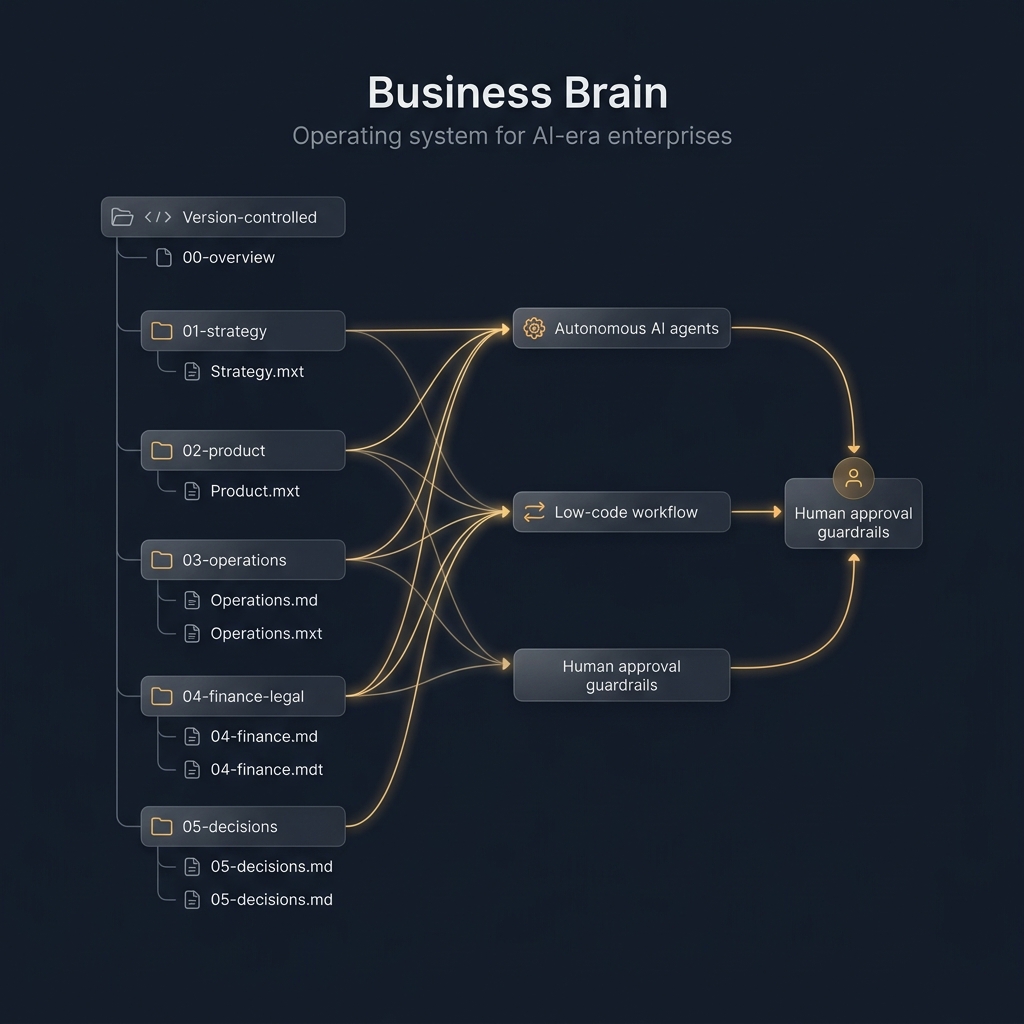
A Business Brain is a centralized, modular folder of plain-text Markdown documents structured like a software repository. It stores every core dimension of an enterprise—from high-level mission statements and target demographics to technical architecture, API routes, brand guidelines, unit economics, and Architecture Decision Records (ADRs).
Rather than relying on vague prompts, external agency retainers, or disconnected team memory, AI agents and low-code workflows ingest this repository directly. When strategic or technical decisions evolve, the corresponding Markdown files are updated in the exact same Git commit or Pull Request as the execution code or workflow configuration.
The Business Brain Directory Structure
business-brain/
├── 00-overview/
│   ├── index.md               # Mission, North Star metrics, non-negotiables
│   └── architecture.md        # High-level system & stack topology
├── 01-strategy/
│   ├── positioning.md         # Target audience (ICP), value prop, differentiation
│   └── brand-voice.md         # Style, vocabulary, "words we never use"
├── 02-product/
│   ├── roadmap.md             # Active features, backlog priorities, near-term goals
│   └── tech-stack.md          # DB schemas, edge routes, cloud infrastructure
├── 03-operations/
│   ├── sops/                  # Standard operating procedures (deployments, migrations)
│   └── playbooks/             # Release checklists, incident responses
├── 04-finance-legal/
│   ├── unit-economics.md      # Pricing tiers, cost caps, margin thresholds
│   └── cap-table-summary.md   # Structure & allocation (non-sensitive overview)
└── 05-decisions/ (ADRs)
    ├── 2026-08-01-database-selection.md
    └── 2026-08-11-pricing-structure.md
By keeping operational knowledge in plain-text Markdown files inside Git, non-technical founders and operators preserve complete sovereignty over their business IP. If you change tools, hosting providers, or automation platforms tomorrow, your operational context remains intact and instantly transferable.
3. Key Pillar: Architecture Decision Records (ADRs) as Permanent Context
In traditional setups, the reasoning behind strategic, financial, or architectural choices is lost in ephemeral Slack threads, WhatsApp messages, or unrecorded video calls. Six months later, new team members or AI coding agents undo intentional trade-offs because nobody remembers why a specific decision was made.
In a Business Brain architecture, every major strategic shift or technical trade-off is recorded as an Architecture Decision Record (ADR) inside 05-decisions/. ADRs act as immutable memory, preventing teams and autonomous agents from re-litigating settled decisions or reverting choices without understanding prior context.
Standard ADR Template
# ADR-001: [Short Title of Decision]

* **Status:** [Proposed | Accepted | Deprecated | Superseded]
* **Date:** YYYY-MM-DD
* **Deciders:** [Names / Agent Roles]

## Context & Problem Statement
What business or technical factor triggered this decision?

## Decision Drivers
* Driver 1 (e.g., latency reduction)
* Driver 2 (e.g., monthly cost cap)

## Considered Options
* Option 1: [Description]
* Option 2: [Description]

## Decision Outcome
Chosen Option: **[Option Name]**

### Positive Consequences
* Key benefit 1

### Negative Consequences / Risks
* Key trade-off 1
An Example ADR in Action
Imagine choosing between a closed SaaS automation platform and a self-hosted n8n instance on an EU server. An ADR explicitly documents the decision driver: strict GDPR compliance, zero monthly per-execution charges, and total data sovereignty. When an AI agent later reviews system architecture, it reads 05-decisions/2026-08-01-database-selection.md and immediately honors those guardrails instead of proposing non-compliant cloud workarounds.
4. The 4 Operational Principles of Managing Companies as Code
Building a Business Brain transforms operations from reactive firefighting into a calm, predictable system. Four core principles guide this approach:
1. Plain-Text & Git Sovereignty (Zero Vendor Lock-in)
Proprietary knowledge bases lock your operational intelligence behind monthly subscriptions and walled gardens. Plain-text Markdown stored in Git gives you 100% ownership. It is human-readable, machine-readable, and compatible with every major AI model and development environment.
2. Single-Commit Atomicity (Context & Code Evolve Together)
When a business rule, pricing tier, or compliance standard changes, the corresponding file in 01-strategy/ or 04-finance-legal/ is updated in the exact same Git commit as the underlying n8n workflow or codebase. Operational context never falls out of sync with actual execution.
3. Clear Safety Rails over Complex Magic
Rather than allowing AI agents to operate in an unconstrained environment, the Business Brain acts as a perimeter of safety rails. Agents ingest 01-strategy/brand-voice.md (e.g., “words we never use”) and 00-overview/index.md (non-negotiables) before generating output, keeping branding and compliance tight automatically.
4. Quiet Operations & Audit-Proof History
Because every change to your Business Brain is tracked through Git history, leaders enjoy complete visual transparency. You know exactly who approved a policy change, when an ADR was updated, and why an operational rule was modified—providing built-in compliance auditing without extra administrative overhead.
Conclusion: Reclaim Operational Focus with a Calm, Indestructible Operating System
Managing your company as code turns documentation from a forgotten administrative chore into your most valuable operational asset. By providing autonomous AI agents and low-code workflows with a structured, version-controlled Business Brain, non-technical leaders eliminate context drift, protect their margins, and reclaim cognitive headspace for high-leverage strategic growth.
If you are ready to structure your business context into a version-controlled Business Brain and pair it with calm, reliable low-code automation, I can help you design and deploy your custom system blueprint.
Transparency Notice: In compliance with European Union regulations (EU AI Act, Regulation (EU) 2024/1689, Article 50), this article was co-authored with AI assistance to support technical research, data structuring, and editorial formatting.