
The Low-Code Maturity Model: A Roadmap for Automation Growth
As an EU business owner, you know administrative busywork is a heavy anchor. In previous articles, I have shown that manual tasks consume 40% or more of staff time, leading to employee burnout, compliance errors, and slower cash flow.
The problem is real, but the fear of fixing it is often bigger. Many managers avoid automation because they think it requires a massive, high-risk IT overhaul. They envision expensive consultants and months of disruption.
The truth is, scaling automation is a journey of intentional, low-risk steps. The Low-Code Maturity Model is the strategic solution. It is a phased approach that starts small, guarantees immediate Return on Investment (ROI) at each step, and uses your existing low-code tools to systematically eliminate administrative risk without ever overcommitting your resources.
1. Why Businesses Fear Automation (And Why They Shouldn’t)
Your fear is valid if you believe that automation means spending 50k euros on a complex software project. But that outdated model is what locks businesses into constant fire-fighting mode, managing administrative tasks that freeze cash flow and risk penalties from auditors like Sanepid or the Finanzamt.
My strategic solution is different. It is built on three levels of growth that ensure you maximize your team’s creative purpose while maximizing compliance and security.
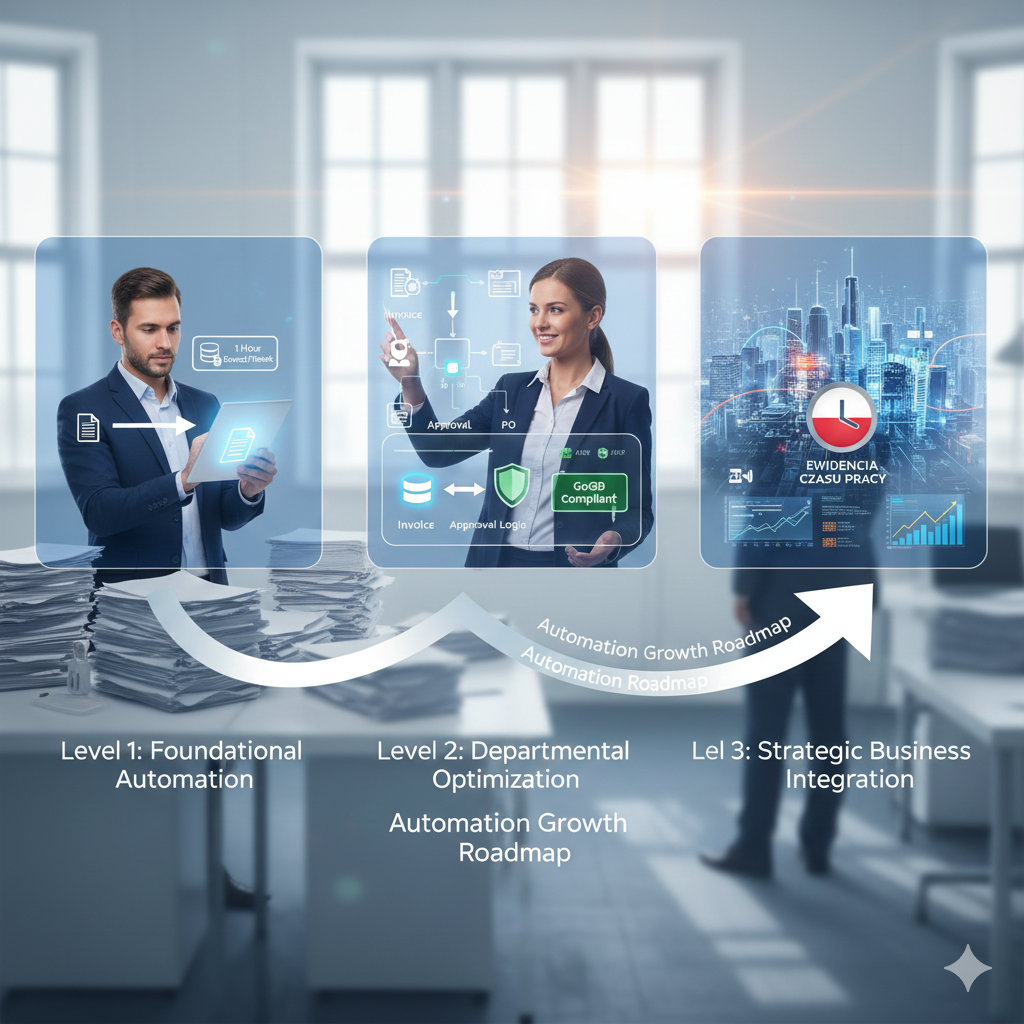
2. Level 1: Foundational Automation (The Quick Wins)
During this phase, we prove the value of automation immediately. We focus entirely on eliminating single-task friction points, which are the tasks that annoy you most and waste the most minutes.
Focus: Eliminating single-task friction.
Key Characteristics:
- Targets tasks identified by the “Rule of Three”: The processes you do over and over again.
- Simple Data Movement: The automation involves a straight, linear move of data from point A to point B.
Goal: Instant time savings of one to two hours a week for every staff member involved in the task.
Examples of Quick Wins:
- Compliance: Automatically verifying a VAT ID (VIES check) on every new order submission. This saves time and ensures legal accuracy upfront.
- Administration: Automatically taking data from a website inquiry form and populating the correct fields in your CRM. Your sales team gets information instantly without copy-paste errors.
At this level, you reclaim immediate, guaranteed time and build confidence in the system.
3. Level 2: Departmental Optimization (Integrated Workflows)
Once you have secured the quick wins, we move to integrating processes and introducing intelligent decision-making to eliminate human error within a single department.
Focus: Standardizing processes and reducing human error.
Key Characteristics:
- Smart Logic: The automation introduces basic logic and conditional routing (e.g., If this data point is X, then send the invoice to Manager Y).
- Auditable Workflow: The solution connects multiple steps into a fully traceable, auditable workflow (Data Input → Check → Approval → Storage).
Goal: Strengthen compliance security and eliminate systemic friction points within the department.
Examples of Optimization:
- Finance: Automated Accounts Payable (AP). The system performs the Three-Way Match (Invoice, Purchase Order, Goods Receipt) and automatically routes the matched invoice for final approval. This is your most potent defense against GoBD compliance risk.
- Operations: Automated Sanepid/HACCP logging. Staff logs a temperature on a tablet, and the system instantly flags a breach and sends an immediate alert to management.
Your processes become reliable and your staff become from data entry clerks to proactive managers.
4. Level 3: Strategic Business Integration (The Scalable Platform)
This is the highest level of maturity, where automation becomes a strategic tool for growth rather than a time-saver.
Focus: Achieving complete financial and operational visibility by connecting different business functions.
Key Characteristics:
- Breaking Silos: The solution connects three or more major functions (Finance, Operations and Sales) for seamless data flow.
- Complex Aggregation: The system aggregates complex data from multiple sources for mandatory compliance reporting and better decision-making.
Goal: Secure the business against major financial leaks, eliminate payment backlogs, and accelerate strategic growth.
Examples of Integration:
- Financial Control: Real-time integration of time tracking data (ewidencja czasu pracy for Polish firms) with job costing and invoicing systems. This guarantees accurate project profitability and accelerates client invoicing, permanently eliminating the “Invisible Profit Drain.”
- Risk Mitigation: Creating a single, automated dashboard that tracks all major compliance metrics (VAT status, hygiene logs, mandatory time records) for proactive, centralized oversight.
You move beyond saving time. You gain strategic control and a sustainable competitive advantage over your competition.
Conclusion: Your Intentional Journey to Growth
Scaling automation is a journey of intentional, low-risk steps. The Low-Code Maturity Model provides the confidence to start small, the proof to expand, and the control to manage your growth. The goal is: maximize your team’s creative purpose while maximizing compliance security.
Ready to identify your current maturity level and the first task you can automate today?